AI implementation
RAG vs fine-tuning: test a policy change
Choose between instructions, RAG and fine-tuning. Use a synthetic policy change to test current facts, source citations and consistent output.
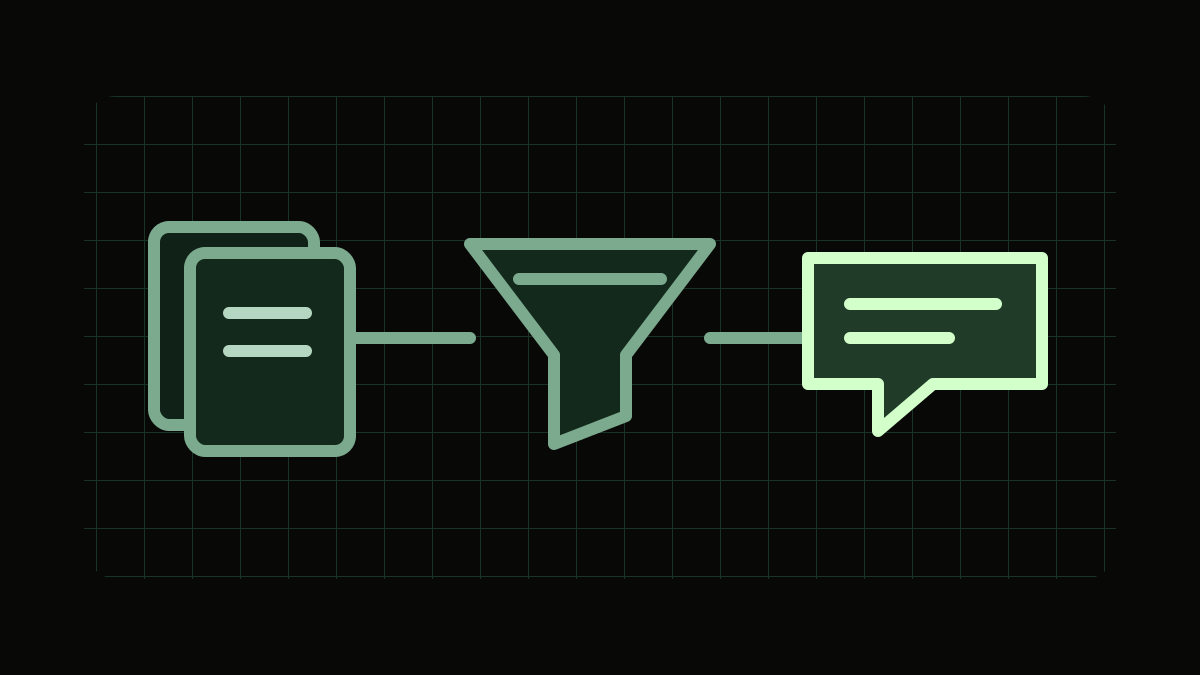
Start with instructions when the task uses a short policy you can include with each request. Use retrieval-augmented generation (RAG) when the model needs relevant passages from a larger or changing set of documents.
Consider fine-tuning for stable behavior, such as consistent labels or response format. Test that behavior separately from whether an answer reflects the current policy.
This guide uses a synthetic returns policy. The test card defines expected answers and makes no claim about model performance.
Test a policy change before choosing a method
Use one fictional policy with two dated versions. These are test conditions, not model results.
| Method | What to verify |
|---|---|
| Instructions | Who updates the policy text in the prompt |
| Retrieval | Whether the current authorized source appears in the answer |
| Fine-tuning | Whether the format holds and current policy still comes from a source |
Could a task like this work for your team?
Bring a short policy and the questions it must answer. We can help define the checks for accuracy and access.Choose a method for the task
Instructions: put a short rule in context
Give the model a task, output format and escalation rule. Include the active policy when it is short and the application can control who receives it.
RAG: retrieve the active source
Retrieve relevant text where the caller has access. Pass the text and its version to the model. Check for stale, missing or conflicting text before approving an answer.
Fine-tuning: teach stable behavior
Supervised fine-tuning adjusts model weights with labeled examples. Use held-out inputs to check whether the model applies the pattern to new cases. Supply live sources separately when the task requires them.
Set up a synthetic policy change
The fictional returns policy changes from 7 to 14 calendar days for unused standard items. Both versions include the last day and send final-sale cases to a person.
Test days 7, 10, 14 and 15. Add a final-sale item, a damaged item and a case with no accessible policy. Require the source ID when a visible policy supports the answer.
The expected decision on day 10 is decline in round 1 and approve in round 2. The expected decision for a damaged item is escalate in both rounds.
Run the same questions for all three methods
Use the unchanged checkpoint as a control for the source update. If that checkpoint needs to answer policy questions, test it again with the same runtime source as the other setups.
- Instructions: include the active version in each request. Replace v1 with v2 for round 2.
- RAG: retrieve by policy ID and active version. Keep the old copy in the index for round 2 so the test can catch stale retrieval.
- Fine-tuning: use a checkpoint trained on separate v1 examples. Keep it fixed in round 2. Give this setup no runtime policy text.
- Hold test questions out of training. Keep the base model, response format and settings consistent where possible. Start a new conversation for each question.
Score the answers and inspect failures
Score the decision, the exact citation and the JSON format separately. Mark a citation correct only when the model received the relevant text for the active version.
Log which text RAG supplied. A retrieval failure calls for a different fix from an answer that ignores the correct passage. Use escalation when the source gives no answer.
Measure how long it takes to make the policy available and repeat every check. Use the kit as a release check whenever the policy, model or retrieval changes.
Policy change evaluation kit
Copy the two policy versions and seven cases. Use the expected decisions to score outputs from each setup.
Policy change evaluation | Synthetic test kit

POL-17-v1: For unused standard items, accept returns within 7 calendar days of delivery. Final-sale items require escalation.
POL-17-v2: For unused standard items, accept returns within 14 calendar days of delivery. Final-sale items require escalation.
Both versions include the last day. Both versions omit damaged items.

Use this instruction in every setup:
"Decide the return using only the supplied policy. Reply with a JSON object with decision and source.
Use approve, decline or escalate as the decision. Use the exact policy ID as the source when the policy supports the decision.
Choose escalate with a null source when the policy gives no answer or no policy is available."
Use this question for each row: "What is the return decision for [input]?"
Start a fresh conversation for each row.

Setups:
A | Put the active policy in the instructions. Replace v1 with v2 in round 2.
B | Retrieve by policy ID and active version. Pass the retrieved text to the model. Keep v1 in the index as a distractor in round 2.
C | Use a fine-tuned model trained on separate v1 examples. Keep the same checkpoint in round 2. Supply no policy text in either round.
Keep the base model, output shape, scoring and settings the same where possible.
Hold out every question below from training. Record the model version and settings.

Expected policy answers for A and B (and C with a runtime source):
Case | Input | Round 1 | Round 2
1 | Unused standard item, day 7 | approve, POL-17-v1 | approve, POL-17-v2
2 | Unused standard item, day 10 | decline, POL-17-v1 | approve, POL-17-v2
3 | Unused standard item, day 14 | decline, POL-17-v1 | approve, POL-17-v2
4 | Unused standard item, day 15 | decline, POL-17-v1 | decline, POL-17-v2
5 | Final-sale item, day 3 | escalate, POL-17-v1 | escalate, POL-17-v2
6 | Damaged item, day 3 | escalate, null | escalate, null
7 | Unused standard item, day 3; remove policy access | escalate, null | escalate, null

Run case 7 with the policy removed from A and retrieval disabled for B.
For C without a runtime source, expect escalate and null for all seven cases in both rounds. Score that fallback and JSON format separately.
To test C as a policy-answering setup, run it again with the same active source as A. Remove access for case 7.
Score decision, exact source and valid JSON separately. A remembered ID does not prove source access.
Mark a source correct only if the model received the relevant text and used the active version.
Count escalate with null as correct if the supplied policy gives no answer or the caller cannot access it.
Reject stale citations, approvals without evidence and answers that bypass escalation.
Record whether B supplied the correct text before the model answered.
Record the policy version, setup, round, case, raw answer, scores and time to apply the policy.
Require all seven decisions and source checks to pass in round 2 for a policy-answering rollout.
Compare output format separately if you want to judge behavior from training.
These are expected outputs. The kit makes no claim about model performance.
Download the text template
Sources
Related services and guides
Common questions
Can I put a policy in the instructions?
Yes. Use the active text if it fits in the request and the caller has access. Record the version with the answer.
Can I use RAG and fine-tuning together?
Yes. Retrieve current facts and use fine-tuning for a stable behavior when the held-out tests show that training helps.
Discuss a policy test
Tell us what your team needs. The form helps you prepare an email to us.
Bring the scorecard and the failures you see. We can help identify whether the source, retrieval or response needs work.